skip to main |
skip to sidebar
These requirements are grouped according to testing activity.A test model should:- force a testing reaction to every code handoff in the project.
- require the test planner to take explicit, accountable action in response to dropped handoffs, new handoffs, and changes to the contents of handoffs.
- explicitly encourage the use of sources of information other than project
documentation during test design. - allow the test effort to be degraded by poor or late project documentation, but prevent it from being blocked entirely.
- allow individual tests to be designed using information combined from various sources.
- allow tests to be redesigned as new sources of information appear.
- include feedback loops so that test design takes into account what’s learned by running tests.
- allow testers to consider the possible savings of deferring test execution.
- allow tests of a component to be executed before the component is fully assembled.
The V model is fatally flawed, as is any model that:- Ignores the fact that software is developed in a series of handoffs, where each handoff changes the behavior of the previous handoff,
- Relies on the existence, accuracy, completeness, and timeliness of development documentation,
- Asserts a test is designed from a single document, without being modified by later or earlier documents, or
- Asserts that tests derived from a single document are all executed together.
I have sketched – but not elaborated – a replacement model. It organizes the testing effort around code handoffs or milestones. It takes explicit account of the economics of testing: that the goal of test design is to discover inputs that will find bugs, and that the goal of test implementation is to deliver those inputs in any way that minimizes lifecycle costs.
The model assumes imperfect and changing information about the product. Testing a product is a learning process. In the past, I haven’t thought much about models. I ostensibly used the V model. I built my plans according to it, but seemed to spend a lot of my time wrestling with issues that the model didn’t address. For other issues, the model got in my way, so I worked around it.
I hope that thinking explicitly about requirements will be as useful for developing a testing model as it is when developing a product. I hope that I can elaborate on the model presented in this paper to the point that it provides as much explicit guidance as the V model seems to.
Let’s step back for a second. What is our job?There are times when some person or group of people hands some code to other peopleand says, “Hope you like it.” That happens when the whole project puts bits on a CD andgives them to customers. It also happens within a project:· - One development team says to other teams, “We’ve finished the XML enhancementsto the COMM library. The source is now in the master repository; the executablelibrary is now in the build environment. The XARG team should now be unblocked –go for it!”·
- One programmer checks in a bug fix and sends out email saying, “I fixed the bug inallocAttList. Sorry about that.” The other programmers who earlier stumbled overthat code can now proceed.
In all cases, we have people handing code to other people, possibly causing themdamage. Testers intervene in this process. Before the handoff, testers execute the code,find bugs (the damage), and ask the question, “Do you really want to hand this off?” Inresponse, the handoff may be deferred until bugs are fixed.This act is fundamental to testing, regardless of the other things you may do. If you don’texecute the code to uncover possible damage, you’re not a tester.Our test models should be built around the essential fact of our lives: code handoffs.Therefore, a test model should force a testing reaction to every code handoff in theproject. I’ll use the XML-enhanced COMM library as an example. That’s a handoff from oneteam to the rest of the project. Who could be damaged?- It might immediately damage the XARG team, who will be using those XMLenhancements in their code.
- It might later damage the marketing people, who will be giving a demonstration ofthe “partner release” version of the product at a trade show. XML support is animportant part of their sales pitch.
- Still later, it might damage a partner who adopts our product.

We immediately have some interesting test planning questions. The simple thing to do would be to test the XML enhancements completely at the time of handoff. (By “completely,” I mean “design as many tests for them as you ever will.”) But maybe some XML features aren’t required by the XARG team, so it makes sense to test them through
the integrated partner release system. That means moving some of the XML-inspired testing to a later handoff. Or we might move it later for less satisfying reasons, such as that other testing tasks must take precedence in the near term. The XARG team will have to resign itself to stumbling over XML bugs for a while.
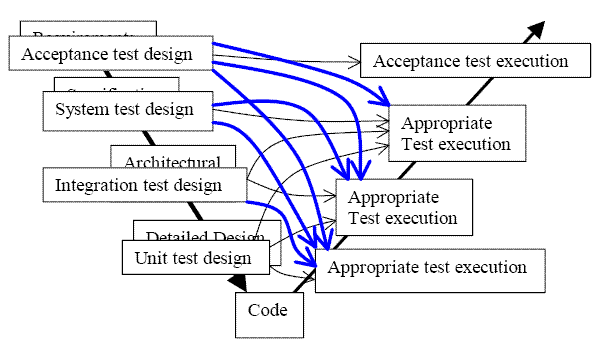
Our testing plan might be represented by a testing schedule that annotates the
development timeline.
In the previous diagram, we had arrows pointing upward (effectively, later in time). It can also make sense to have arrows pointing downward (earlier in time):
In that case, the boxes on the left might be better labeled “Whatever test design can be done with the information available at this point”.
Therefore, when test design is derived from a description of a component of the system, the model must allow such tests to be executed before the component is fully assembled.
I have to admit my picture is awfully ugly – all those arrows going every which way. I have two comments about that:- We are not in the business of producing beauty. We’re in the business of finding as many serious bugs as possible as cheaply as possible.
- The ugliness is, in part, a consequence of assuming that the order in which developers produce system description documents, and the relationships among those documents, is the mighty oak tree about which the slender vine of testing twines. If we adopt a different organizing principle, things get a bit more pleasing. But they’re still complicated, because we’re working in a complicated field.
The V model fails because it divides system development into phases with firm
boundaries between them. It discourages people from carrying testing information across those boundaries. Some tests are executed earlier than makes economic sense. Others are executed later than makes sense.Moreover, it discourages you from combining information from different levels of system description. For example, organizations sometimes develop a fixation on “signing off” on test designs. The specification leads to the system test design. That’s reviewed and signed off. From that point on, it’s done. It’s not revised unless the specification is. If information relevant to those tests is uncovered later – if, for example, the architectural design reveals that some tests are redundant – well, that’s too bad. Or, if the detailed design reveals an internal boundary that could easily be incorporated into existing system tests, that’s tough: separate unit tests need to be written.Therefore, the model must allow individual tests to be designed using information combined from various sources.
And further, the model must allow tests to be redesigned as new sources of
information appear.
There’s always some dispute over how big a unit should be (a function? a class? a collection of related classes?) but that doesn’t affect my argument. I believe, a unit is the smallest chunk of code that the developers can stand to talk about as an independent entity.
The V model says that someone should first test each unit. When all the subsystem’s units are tested, they should be aggregated and the subsystem tested to see if it works as a whole.
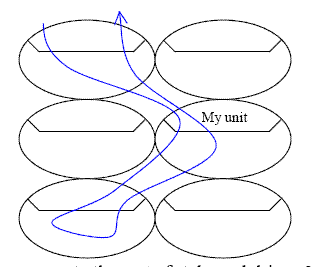
So how do we test the unit? We look at its interface as specified in the detailed design, or at the code, or at both, pick inputs that satisfy some test design criteria, feed those inputs to the interface, then check the results for correctness. Because the unit usually can’t be executed in isolation, we have to surround it with stubs and drivers, as shown at the right. The arrow represents the execution trace of a test.
That’s what most people mean when they say “unit testing”.

I think that approach is sometimes a bad idea. The same inputs can often be delivered to the unit through the subsystem, which thus acts as both stub and driver. That looks like the picture to the right.
The decision about which approach to take is a matter of weighing tradeoffs. How much would the stubs cost? How likely are they to be maintained? How likely are failures to be masked by the subsystem? How difficult would debugging through the subsystem be? If tests aren’t run until integration, some bugs will be found later. How does the estimated cost of that compare to the cost of stubs and drivers? And so forth.The V model precludes these questions. They don’t make sense. Unit tests get executed when units are done. Integration tests get executed when subsystems are integrated. End of story. It used to be surprising and disheartening to me how often people simply wouldn’t think about the tradeoffs – they were trapped by their model.
Therefore, a useful model must allow testers to consider the possible savings of deferring test execution.

A test designed to find bugs in a particular unit might be best run with the unit in isolation, surrounded by unit-specific stubs and drivers. Or it might be tested as part as the subsystem – along with tests designed to find integration problems. Or, since a subsystem will itself need stubs and drivers to emulate connections to other subsystems, it might sometimes make sense to defer both unit and integration tests until the whole system is at least partly integrated. At that point, the tester is executing unit, integration, and system tests through the product’s external interface. Again, the purpose is to minimize total lifecycle cost, balancing cost of testing against cost of delayed bug discovery. The distinction between “unit”, “integration”, and “system” tests begins to break down. In effect, you have the above picture.
It would be better to label each box on the right “execution of appropriate tests” and be done with it. What of the left side? Consider system test design, an activity driven by the specification. Suppose that you knew that two units in a particular subsystem, working in conjunction, implemented a particular statement in the specification. Why not test that specification statement just after the subsystem was integrated, at the same time as tests derived from the design? If the statement’s implementation depends on nothing outside the subsystem, why wait until the whole system is available? Wouldn’t finding the bugs earlier be cheaper?
© blogger templates 3 column | Make Money Online